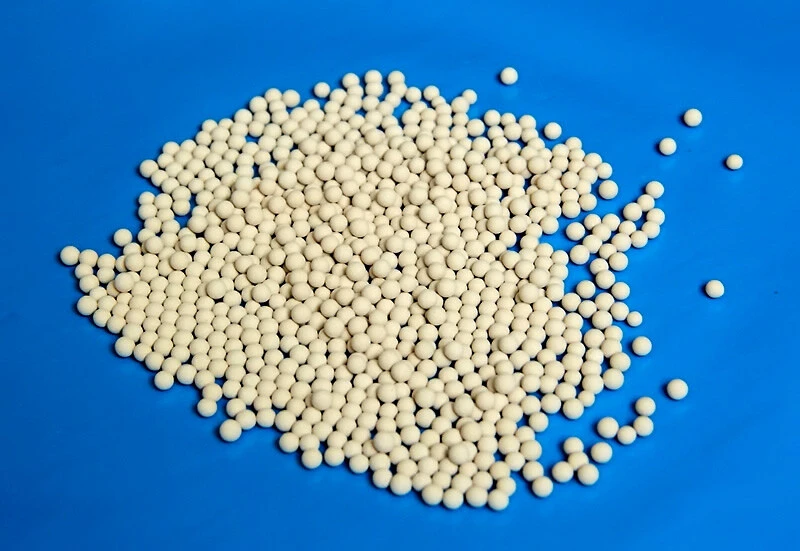
Molecular sieves are the workhorses of industrial dehydration, but their adsorption capacity is finite. Regeneration is the process that returns a saturated sieve to near-original capacity, and doing it correctly determines both energy cost and sieve service life.
Why Regeneration Is Necessary
When a molecular sieve bed saturates, the water and other adsorbed molecules must be driven off before the bed can be used again. Regeneration exploits the equilibrium shift that occurs when temperature rises or pressure falls: at high temperature or low pressure, the sieve releases the adsorbed molecules.
Recommended Regeneration Conditions
- Temperature: 200-350°C (typically 250-280°C for water desorption)
- Heating rate: not more than 10°C per minute to avoid thermal shock and cracking
- Purge gas: dry gas such as nitrogen, dry air or product gas
- Cooling: always cool the bed below 50°C before returning to service
Temperature Profile and Drying Process
Regeneration proceeds in three stages. In the first stage the bed is heated to vaporize loosely held moisture. In the second, the purge gas strips the desorbed water vapor away from the sieve surface; purge direction should be counter-current to the adsorption direction so the cleanest portion of the bed faces the product at the end of regeneration. In the final stage, the bed is cooled, preferably with dry gas so that the sieve does not re-adsorb moisture.
Common Mistakes That Shorten Sieve Life
- Regenerating at too low a temperature, leaving residual water that permanently blocks capacity
- Heating too quickly, causing thermal shock and bead cracking
- Allowing liquid water carryover into the bed, which can shatter beads and cause pressure-drop spikes
- Returning a hot bed to service, which causes immediate temperature-front damage
How Often Should Sieves Be Regenerated?
Cycle time depends on feed conditions and dew point requirement. In heatless dryers the cycle is minutes; in large natural gas dehydration units it is typically 12-24 hours. As a rule of thumb, plan regeneration before the effluent dew point approaches the specification limit.
FAQ
Can molecular sieves be over-regenerated? Yes. Excessive temperature above 400°C can permanently destroy the zeolite crystal structure and reduce capacity.
What is the normal sieve service life? With correct regeneration, 3-5 years is typical, after which capacity fade from hydrothermal aging and fouling justifies replacement.
Proper regeneration is the single most important factor in molecular sieve operating economics. If you need assistance selecting regeneration settings for your process, contact our technical team.




Comments (0)
No comments yet. Be the first to share your thoughts.
Leave a Comment